01
Planning the system around the reactors
The course scenario considered a distributed small modular reactor (SMR) network in Alberta. Our task was to propose how its radioactive waste could be collected, transported, and stored over the long term. The study combined storage architecture, transport access, lifecycle costs, and the needs of communities and Indigenous rights holders.
The deliverable was a concept report and presentation. No facility was built, site investigated, or containment performance tested. The scenario’s emissions-reduction goal was a planning objective, not a result achieved by this project.
02
My contribution within the team
I worked within a five-person team on the proposal. My documented contributions included the introduction, project planning, final design configuration, transportation write-up, and report integration and editing. The concept selection, economic estimates, and final recommendation are team outputs.
03
Turning a broad brief into criteria
We developed 13 weighted criteria covering safety, environmental impact, transport risk, long-term containment, cost, regulatory feasibility, technical maturity, expansion, and community considerations. The team assigned weights through discussion: public and worker safety carried 15 points, environmental impact 12, and long-term containment reliability 10, out of 100 total.
The proposed system needed transport redundancy, room for future capacity, ongoing monitoring, and an approach to community participation. These were design requirements; compliance, community agreement, and site suitability were not established by the study.
04
Comparing three storage architectures
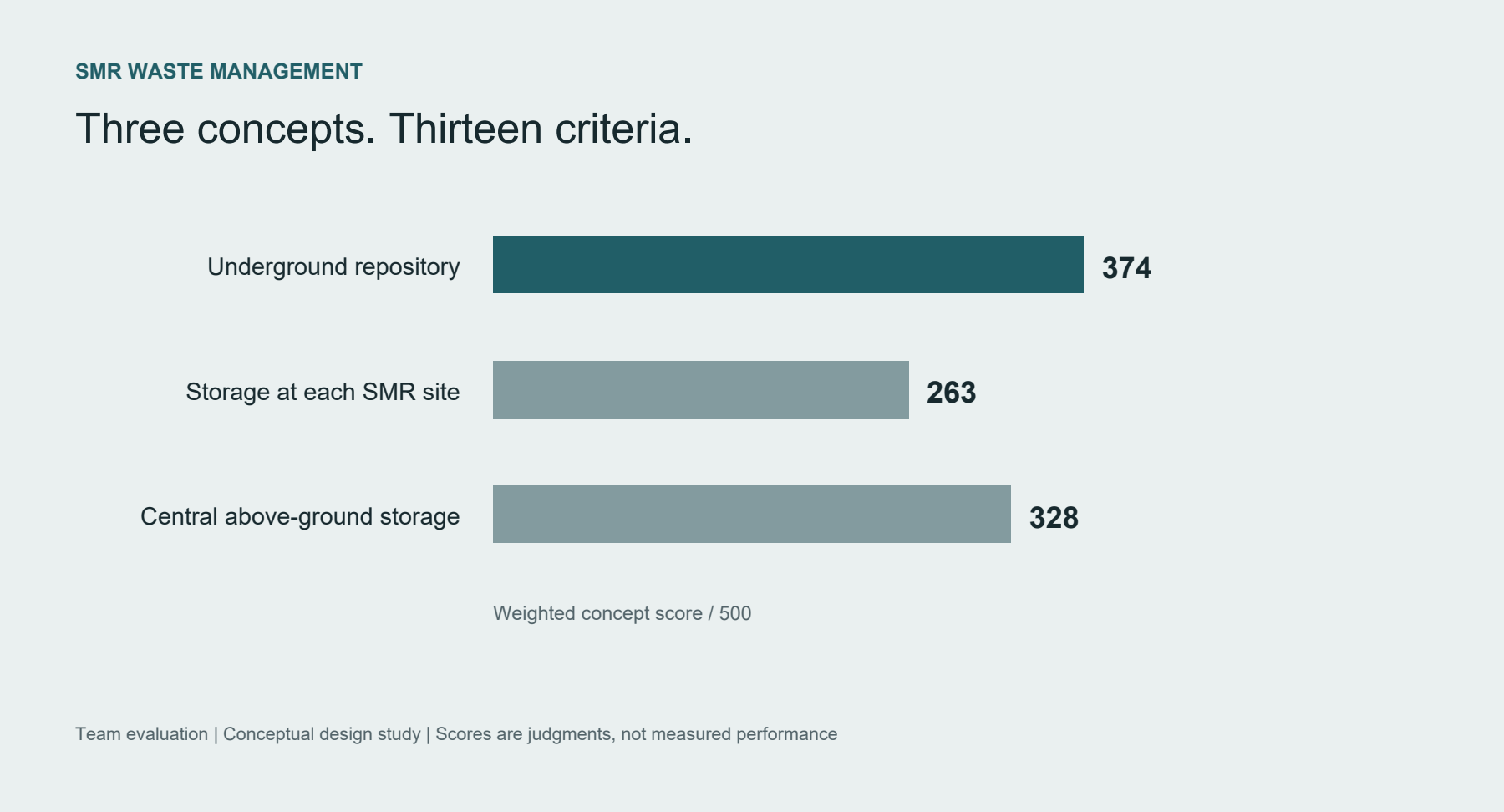
| Concept | Principal tradeoff | Weighted score / 500 |
|---|---|---|
| Central underground repository | Higher initial construction effort versus the proposed long-term containment and shared infrastructure benefits | 374 |
| Storage attached to each SMR | Less off-site transport versus duplicated facilities and continued on-site management | 263 |
| Central above-ground storage | Shared infrastructure and accessible monitoring versus continued surface storage and future disposal needs | 328 |
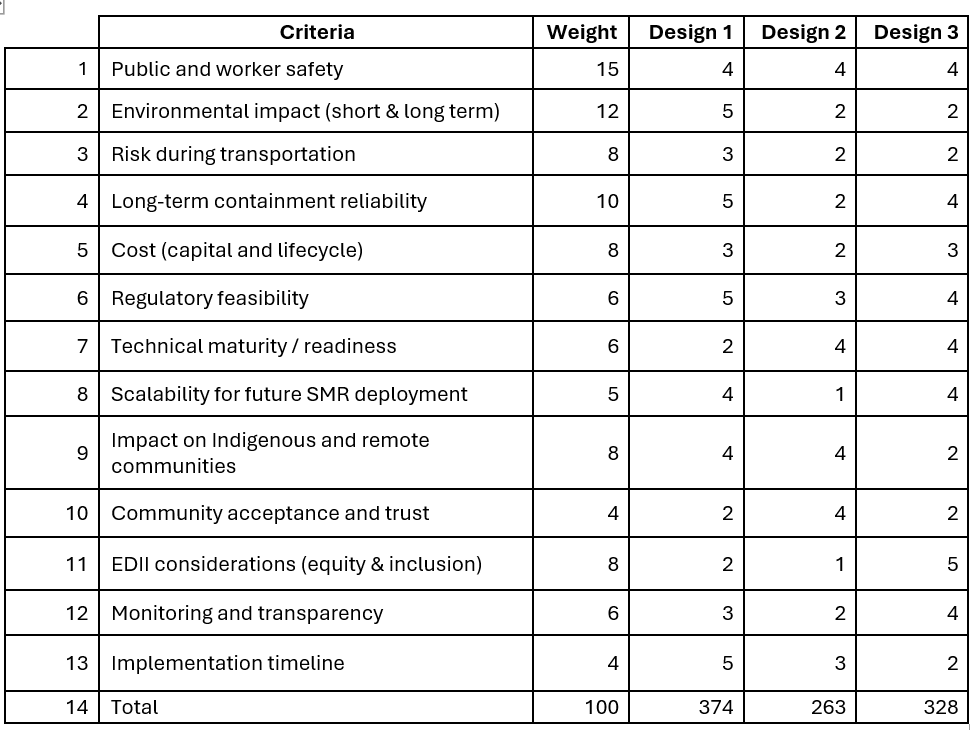
The underground concept ranked highest under our selected weights. We combined it with community oversight proposed for the above-ground alternative. A weighted matrix made the tradeoffs explicit, but its ranking depended on qualitative ratings; it was not a substitute for a site-specific safety assessment.
05
Selected concept and transport strategy
The selected concept proposed a centralized repository in an east-central Alberta salt formation, with storage vaults 600–800 m below ground, a surface receiving facility, and shaft access. The depth and geology were concept assumptions, not a validated site design.
Road transport was the initial primary mode because it offered access and flexibility across dispersed reactor sites. Rail provided a secondary route and a potential larger role as the network expanded. This balanced near-term access against the study’s anticipated long-term transport efficiencies.
The proposal included staged underground expansion, monitoring, and Indigenous and local-community participation in oversight. These were recommendations, not evidence of consultation, consent, or implemented governance.
06
Looking beyond construction cost
The economic study separated capital and indirect costs, annual operating costs, and long-term stewardship. The team’s preliminary capital estimate was approximately CAD $3.3–6.9 billion, presented as an order-of-magnitude planning range. It was not a tender estimate or independently validated budget.
The key decision was whether shared infrastructure and long-term management could justify higher initial construction costs. Staffing, monitoring, transport, closure, and stewardship all affected the comparison. I helped integrate the final recommendation and its supporting discussion into the report.
07
Planning and communication
The project plan used a Gantt chart to coordinate drafting, internal reviews, editing, presentation preparation, and submission milestones. The report and presentation connected the selected storage concept to its transport strategy and the wider economic, environmental, and social considerations.
08
What the study demonstrates
This project demonstrates structured concept selection, systems-level tradeoffs, and communication of a multidisciplinary proposal. It also illustrates the limits of early design: a preferred concept is only as strong as its assumptions and supporting evidence.
- A next-stage study would test how alternative weights and ratings change the concept ranking.
- Site-specific geology, groundwater, thermal behaviour, and waste compatibility would need specialist investigation.
- Waste inventories, transport routes, handling requirements, and cost assumptions would need reconciliation and validation.
- Formal regulatory review and meaningful engagement with Indigenous rights holders and affected communities would be essential before implementation.