01
The project brief
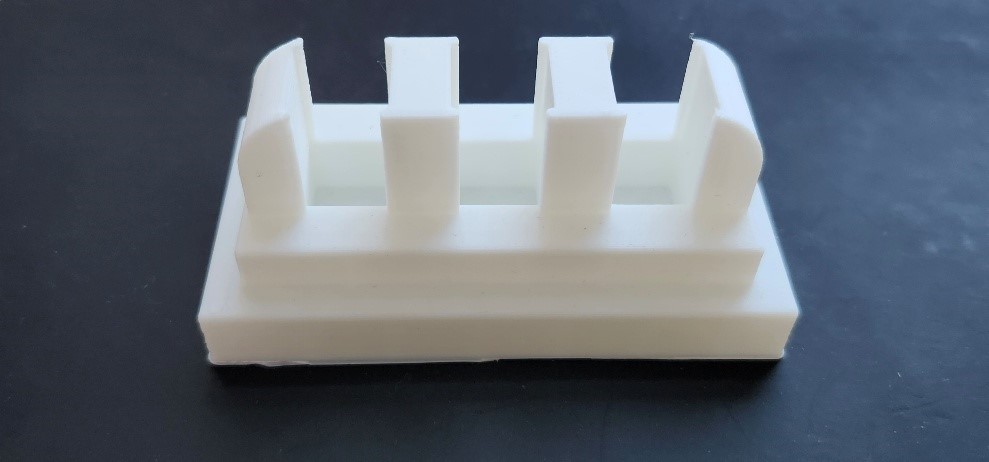
Our team developed a method for investigating soil nutrients in a Mars-exploration scenario for Queen’s Space Engineering Team (QSET). The work connected a landing-site recommendation with three proposed nutrient tests and a physical holder for viewing samples in standard cuvettes.
We completed a printed holder, an annotated Gusev Crater map, and a laboratory sulfate-test demonstration. The work was a course prototype and research exercise; environmental qualification and integration into a rover were outside the demonstrated results.
02
My role within the team
Responsibilities were shared across the team. I contributed to research, requirements definition, concept evaluation, holder design and prototyping, test development and demonstration, project planning, and presentation. The design and results shown here are shared team accomplishments.
03
Requirements & constraints
| Requirement | Design implication |
|---|---|
| Hold three 12.5 × 12.5 × 45 mm cuvettes | Provide secure seating while preserving a view of each sample |
| Make test results visually observable | Keep the viewing faces open |
| Develop three nutrient-test procedures and demonstrate a feasible test | Balance scientific interest with equipment availability and time |
| Stay within a $100 course budget and $25 printing cap | Limit material use and select accessible testing methods |
| Provide an annotated site image | Include coordinates, scale, direction, and relevant geological features |
The report also considered a future fit with the QSET rover. A confirmed rover installation or tolerance-validated interface was not documented in the supplied files.
04
Selecting a study site
We compared Gale Crater, Elysium, Jezero Crater, Meridiani Planum, and Gusev Crater. Our evaluation weighted accessibility at 37.5%, nutrient supply at 30%, evidence of water at 20%, and climate at 12.5%. Gusev ranked highest in the team’s research-based matrix.
| Candidate | Score / 10 |
|---|---|
| Gusev Crater — selected | 9.3 |
| Gale Crater | 8.5 |
| Meridiani Planum | 8.3 |
| Elysium | 7.8 |
| Jezero Crater | 7.6 |
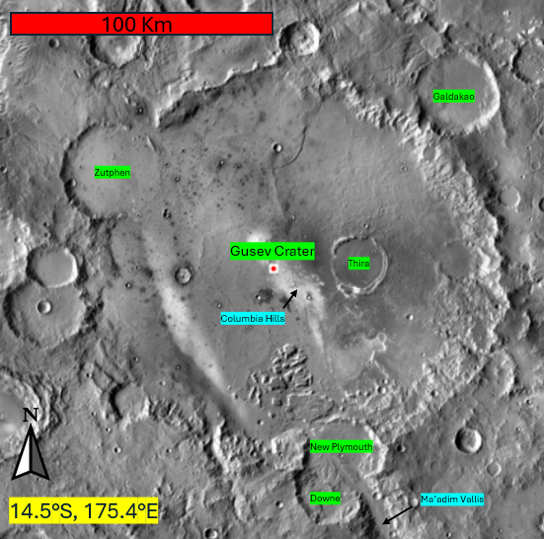
The ranking records our decision process under the chosen criteria. It does not establish that the selected site can support plants or life without further investigation.
05
From concept to printed holder
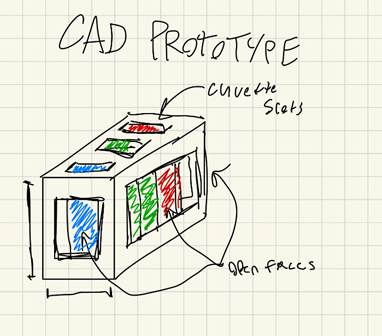
The initial concept used three cuvette slots with open faces for observing the samples. The printed version uses a broad base and open supports, emphasizing a low centre of mass, visibility, and limited material consumption. PLA was specified in the design proposal.
This involved a practical tradeoff: enough support to retain each cuvette, while leaving the liquid visible and avoiding an unnecessarily bulky print. The presentation reports that the holder successfully accommodated three cuvettes; it does not provide retention-force measurements or environmental durability data.
06
Choosing a feasible demonstration
We considered tests for nitrate, sulfate, phosphate, organic matter, and perchlorate. Nitrate, sulfate, and phosphate were selected for procedure development based on the team’s assessment of relevance, cost, and feasibility.
Consultation with university lab technicians narrowed the physical demonstration to barium chloride precipitation for sulfate, using available laboratory equipment. Nitrate and phosphate remained documented procedures rather than completed demonstrations.
| Target | Method discussed in the report | Documented completion |
|---|---|---|
| Sulfate | Barium chloride precipitation | Laboratory demonstration completed |
| Nitrate | Nitrate quick test | Procedure developed |
| Phosphate | Molybdenum blue method | Procedure developed |
The sulfate demonstration relied on a visible precipitate rather than a calibrated numerical readout. The case study documents method selection and observations, not a validated analytical instrument.
07
Laboratory observations
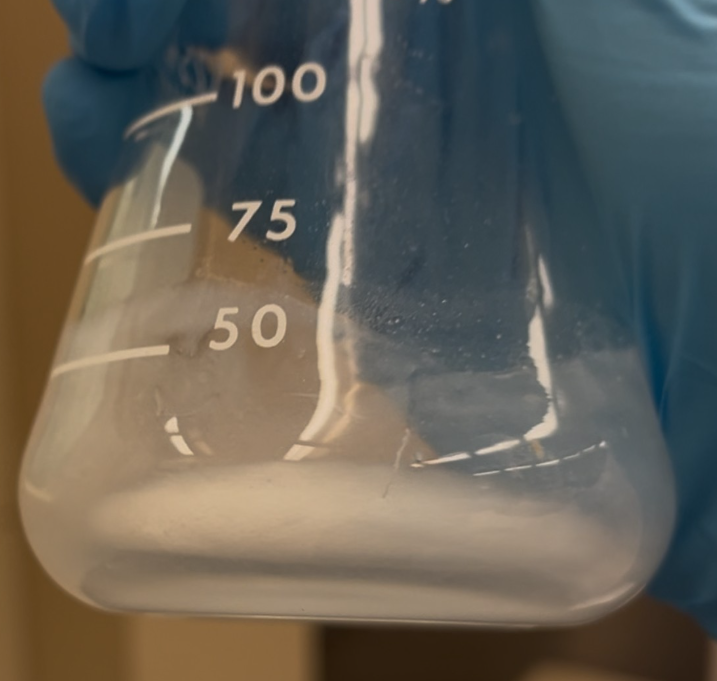
The team tested garden soil and Old Spice Fiji shampoo during the sulfate demonstration. The presentation reports a successful visible result, while noting that soil particles made interpretation difficult and that better filtering was needed.
No calibration curve, detection limit, repeatability data, or quantitative sulfate concentrations were supplied. The demonstration therefore supports qualitative observation of the selected method, rather than proof of nutrient availability on Mars or reliable performance in Martian conditions.
08
Completed outcomes
| Deliverable | Outcome |
|---|---|
| Cuvette holder | Designed and 3D printed; reported to hold three cuvettes successfully |
| Site study | Five candidates evaluated; Gusev Crater selected and mapped |
| Test development | Three nutrient-test procedures developed; sulfate test demonstrated |
| Project cost | $60.35 reported total against the $100 limit |
The report contains an earlier $66.15 estimate including contingency; the $60.35 figure above is the later total reported in the presentation. The available material does not include a final itemized expense ledger.
09
Lessons & future improvements
The work highlighted that a visible reaction is useful only if sample preparation and the viewing arrangement make it interpretable. Soil particles interfered with the observation, linking chemical testing directly to filtration, handling, and fixture design.
- Improve filtration so suspended solids are less likely to obscure the reaction.
- Add controlled references and repeated trials before making accuracy or concentration claims.
- Measure cuvette fit and retention under representative handling and vibration.
- Evaluate materials and test procedures under defined environmental conditions before claiming Mars suitability.
- Explore automated sample handling and rover integration as a separate development stage.
These are proposed improvements; they were not demonstrated as part of the completed course prototype.